Why capable skippers don’t need to feel completely confident to maintain command.
Every confident skipper started as someone who was not entirely sure. But let me assure you – even experienced skippers feel nerves, whether you call it fear or an adrenaline rush (which is what it really is). Experienced skippers evaluate and sometimes question themselves – they encounter new situations. Everyone who has spent meaningful time on a boat knows that things don’t always go exactly as planned.
CONFIDENCE is not the standard.
The goal is COMMAND.
Understanding the difference changes how you train, how you teach, how you evaluate risk and how quickly you become capable of leading a boat and going further, faster with greater ease.
Don’t Repeat the Same Mistakes
People are frequently told to gain confidence by spending more time on the water. Time helps. But repetition alone does not guarantee improvement.
But you can repeat the same rushed docking approach for years. Effective practice requires you to ask yourself:
- What skill do I want to develop?
- What does success look like?
- What are the most important thing am should you observe?
- What will you do if the attempt does not work?
- What did you learn afterward?
This turns repetition into development.
Confidence Comes From Clarity
True confidence is not the belief that nothing will go wrong. It is the belief that you can remain oriented and respond when something does. To get there – you need clarity about:
- Your own skills and limitations
- The capability of the vessel
- The readiness of the crew
- The conditions around you
- The options available if the plan changes
But confidence is also contextual. It can mean that you have a level of comfort – about your own boat, your local waters. Confidence for a boat owner or skipper aboard a bareboat charter should not be dependent on how you feel – it should be based on you ability to understand what is needed for the journey ahead and a commitment to prepare yourself, your crew and your boat for the journey ahead.
A confident skipper can still feel worry, fear, uncertainty – the confidence that counts isn’t bravado, it’s clarity about what’s necessary to maintain command. Clarity about what it takes to safely operate the boat and keep one’s crew safe. Clarity about when a situation has changed – maybe weather, maybe crew capabilities, maybe vessel issues.
You may be comfortable aboard your own boat in familiar waters and less certain aboard a charter boat in a new country. You may dock confidently with your regular crew and become anxious when guests are aboard.
That does not mean your confidence disappeared.
It means the situation changed.
Capable skippers recognize those changes and adjust their preparation.
Confidence is a Feeling
Confidence is how certain you feel about your ability to manage a situation – a feeling that can change as conditions change.
You may feel confident docking your own boat in your home marina – less confident aboard an unfamiliar charter vessel. You may feel more nervous when family members or first-time guests are on board without your regular crew. You may feel confident in close-quarters until you are around multi-million dollar yachts.
Confidence rises and falls as circumstance and conditions change. But your degree of competence hasn’t changed. That is normal. As circumstances change, your inner ‘calm’ may shift as well – as your confidence is based on:
- Familiarity
- Experience
- Conditions
- Vessel familiarity and/or condition
- Crew experience and readiness
- Physical and mental fatigue
- The consequences of getting something wrong
Changes in your internal state is important data to consider. Sometimes it’s a warning that you may be stretching yourself beyond your abilities. But these feelings along don’t erase everything you already know. Using your internal state as an internal ‘barometer’ can give you information you need to adjust plans, increase crew communication, slow down or even make a No-Go decision for leaving a harbour.
Confident people can lack the skills and judgment required for the situation. Nervous people can perform extremely well. Confidence alone is a poor measure of whether someone is ready to take command.
Competence is the Ability to Perform with Skill
Competence is different.
Competence is the ability to carry out a task with sufficient knowledge, skill and consistency.
A competent boater is required to have a basic set of skills and must be able to assess risk based on their abilities, these include:
- Control the vessel at low speed
- Prepare lines and fenders
- Read a chart
- Interpret weather and current information
- Anchor effectively
- Communicate with the crew
- Recognize developing hazards
- Recover from a manoeuvre that is not working
Competence is developed through instruction, practice, feedback and experience.
But competence is not universal. You may be competent in one area and inexperienced in another. You may be competent on your own vessel but need orientation before operating a different boat. You may be highly skilled at navigation and less developed in close-quarters handling. You may be comfortable making decisions for yourself but less experienced leading a crew.
Being competent does not mean being an expert at everything. It means you can identify what the situation requires and understand whether you currently possess those capabilities.
In Skipper’s Mindset Chapter 1 – Tools for Boat Owners – we provide you with tools you can use as you learn your own boat and gain greater levels of competence.
Command is the Ability to Manage the Whole Situation
Command brings confidence and competence together alongside the most important skill of all: judgment.
Command means understanding:
- What you know
- What you can do
- What you do not yet know
- Where the risk is highest
- Where your limits or breaking points may be
- What support, preparation or contingency will compensate for those gaps
- When the correct decision is to slow down, change the plan or say no
Command is not the same as control.
On the water, there are many factors you cannot control: weather, current, mechanical failures, other vessels or the reactions/actions of your crew or other people on the dock. Sometimes these things are happening all at once.
But having a lack of control over all factors – does not mean you have lost command. Command is maintained when you have planned, maintained situational awareness and have allowed yourself sufficient time and distance to anticipate and respond.
Our mantra is that if you can command the moment – you can command the outcome.
Command is not pretending there is no uncertainty. It is remaining oriented within it.
Command as a New Skipper
Many new boaters assume that command belongs only to experts with decades of experience.
It does not. You can begin developing command very early.
New skippers may not possess the technical range of someone with decades on the water. But accurate evaluation of the situation and operating within a comfortable risk profile isn’t about years on the water – it’s about good decision-making:
Good decisions aren’t reserved for people with lots of nautical miles on their belt. Even the most experienced skippers can make poor decisions about the following:
- Close-quarters handling with high winds in difficult slips
- Choosing to bring inexperienced crew on complex journeys
- Failing to prepare a detailed passage plan – or review charts in advance
- Arriving late and failing to plan for an alternate destination for the night
- Underestimate weather forcasts
- Failing to ask for marina assistance
- Choosing to push ahead to meet a schedule
Go/No-Go decisions and choosing a more conservative plan is not weakness. That’s command.
Skippers don’t need to know everything – they need to take limited experience into account and recognize when adding more time, more planning, conservative decisions, more experienced crew or training is needed for the journey ahead.
Decisions Drive Command
An expert may possess tremendous technical ability and experience. But that doesn’t guarantee good command.
Experience can become dangerous when it creates complacency, overconfidence or resistance to changing the plan. Highly experienced skippers can lose command by:
- Ignoring deteriorating conditions
- Continuing because of schedule pressure
- Dismissing crew concerns
- Relying on past success instead of current information
- Refusing assistance
- Treating uncertainty as a challenge to their identity
- Allowing frustration or ego to drive decisions
Conversely, a less experienced skipper may maintain command through disciplined preparation and conservative choices.
Command is not measured solely by what you can accomplish. It’s also measured by what you are willing to avoid. Knowing when to say no is one of the clearest demonstrations of command.
Your crew will not have less confidence in you because you are conservative, express uncertainty or ask for input. On the contrary – demonstrating good decision-making builds trust, the essential quality you need to maintain command and crew cohesion when you need it.
Trading Bigger Problems for Smaller Problems
Before departure or any demanding manoeuvre, ask yourself – where is the biggest risk.
The important question is not simply: “Can I do this.”
Ask yourself:
- What is could cause me to lose control?
- What is the biggest risk I need to avoid?
- What are my options, escape routes and alternatives?
- What are my crews abilities – given their experience level, fatigue or other limitations?
- Am I becoming overloaded as the skipper?
Then determine what will reduce that risk.
You may need:
- More information
- A different route
- An earlier departure
- Additional crew
- An instructor
- Better equipment
- More practice
- A lower weather threshold
- A backup destination
- Permission to cancel
Command is strengthened when you identify the point at which conditions, complexity or stress may exceed your present capacity.
You don’t wait until you reach that point. You plan around it.
Calm Command Does Not Mean Feeling Calm All the Time
The phrase Calm Command™can be misunderstood. It does not mean being permanently cool, serene and untouched by stress.
Real skippers feel adrenaline. They may be concerned, frustrated or afraid. Their heart rate may increase. They may recognize that a situation is more serious than expected.
Calm Command means having enough internal regulation to assess the situation and continue making useful decisions regardless of those feelings.
Emotions are information – but they don’t tell you what to do:
- Fear may tell you that risk has increased.
- Anxiety may reveal uncertainty or inadequate preparation.
- Frustration may indicate that repeated attempts means the method isn’t working.
- Adrenaline may narrow your attention and create pressure to act quickly.
A skipper exercising Calm Command notices internal signals, considers their options and slows down enough to figure out whether:
- “We are going around and trying again.”
- “I need everyone to stop and listen.”
- “This is no longer within our limits.”
- “We are changing destinations.”
- “I need assistance.”
- “We are not leaving today.”
The person may not feel calm. But the decisions are calm, deliberate and effective.
That is how trust is built with your crew and within yourself – that you can handle the problems that come your way.
Reading Your Internal Signals
Under stress, people often speed up – they speak faster, make assumptions, focus on one problem while ignoring others. They forge ahead because stopping feels like failure.
Internal regulation interrupts that escalation.
A skipper can regulate the moment by:
- Reducing speed
- Creating physical space
- Naming the primary risk
- Confirming the vessel’s position
- Clarifying crew roles
- Identifying the safest immediate option
- Delaying non-essential decisions
- Choosing the next manageable action
The goal is not to remove every emotion. It is to maintain enough cognitive capacity to evaluate what is happening. That is Calm Command™.
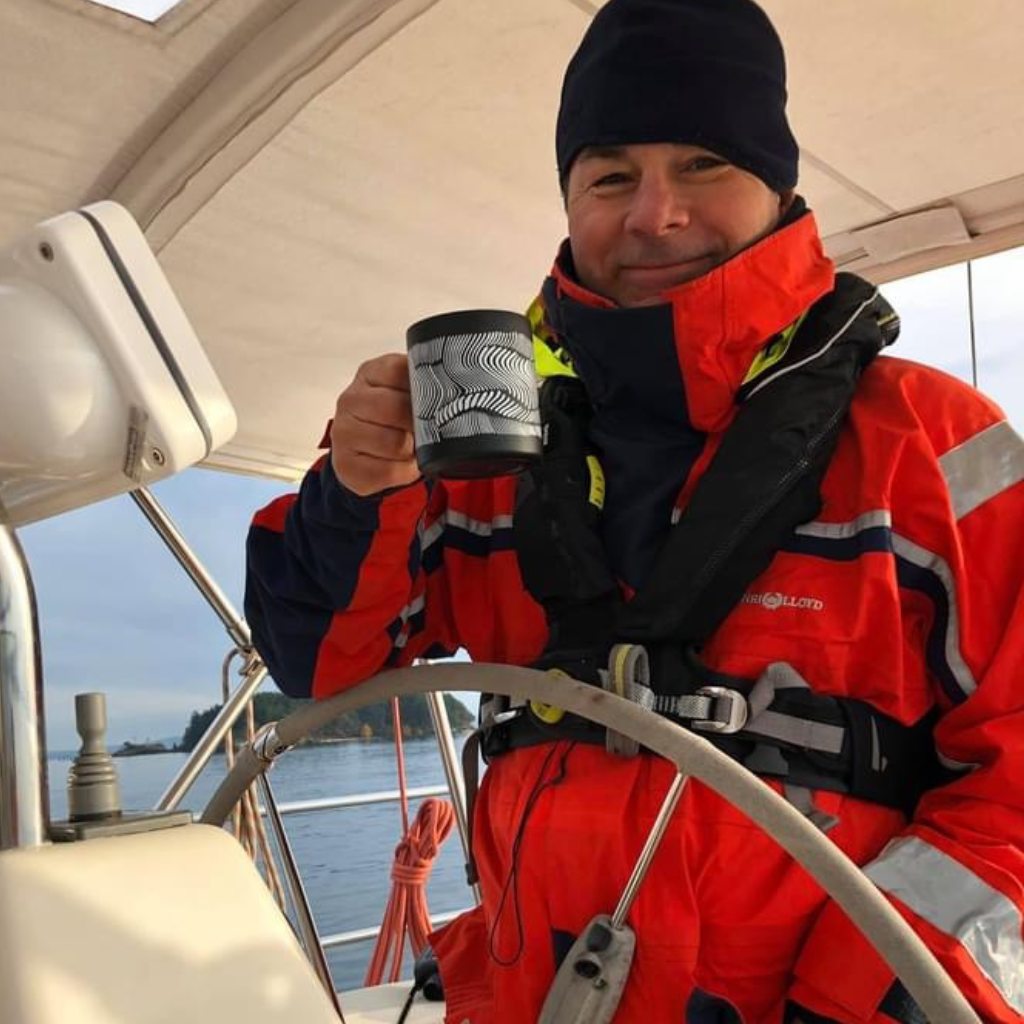
Confidence May Follow—But Command Comes First
Confidence grows as competence develops – but don’t wait to feel completely confident before exercising sound command.
You can feel nervous and still:
- Recognize risk
- Prepare thoroughly
- Communicate clearly
- Make a good decision
- Ask for help
- Maintain control of your vessel
- Stop before the situation escalates
That is successful leadership.
Confidence is welcome.
Competence is necessary.
Command is the goal.
Calm Command Starts Here
You don’t need to know everything before taking the helm. You need the judgment to understand your limits, the competence to manage the situation and the discipline to make good decisions when it matters most.
If you’re ready to develop Calm Command™, we’re ready to help.
Join one of our upcoming courses or book private coaching aboard your own boat.
Together, we’ll build the skills, judgment and confidence to help you command every voyage.
Frequently Asked Questions
What’s the difference between confidence and competence?
Confidence is how certain you feel. Competence is your actual ability to perform with skill. The two don’t always develop at the same pace.
What does “command” mean in recreational boating?
Command is the ability to assess the situation, understand your limits, lead your crew and make good decisions—even when conditions change or you don’t feel completely confident.
Can a beginner have command?
Absolutely. Command comes from preparation, judgment and understanding your limits—not from knowing everything. A new skipper who plans conservatively and recognizes when to ask for help can demonstrate excellent command.
What is Calm Command™?
Calm Command doesn’t mean you never feel nervous. It means you regulate your emotions well enough that fear or adrenaline doesn’t make your decisions for you.