
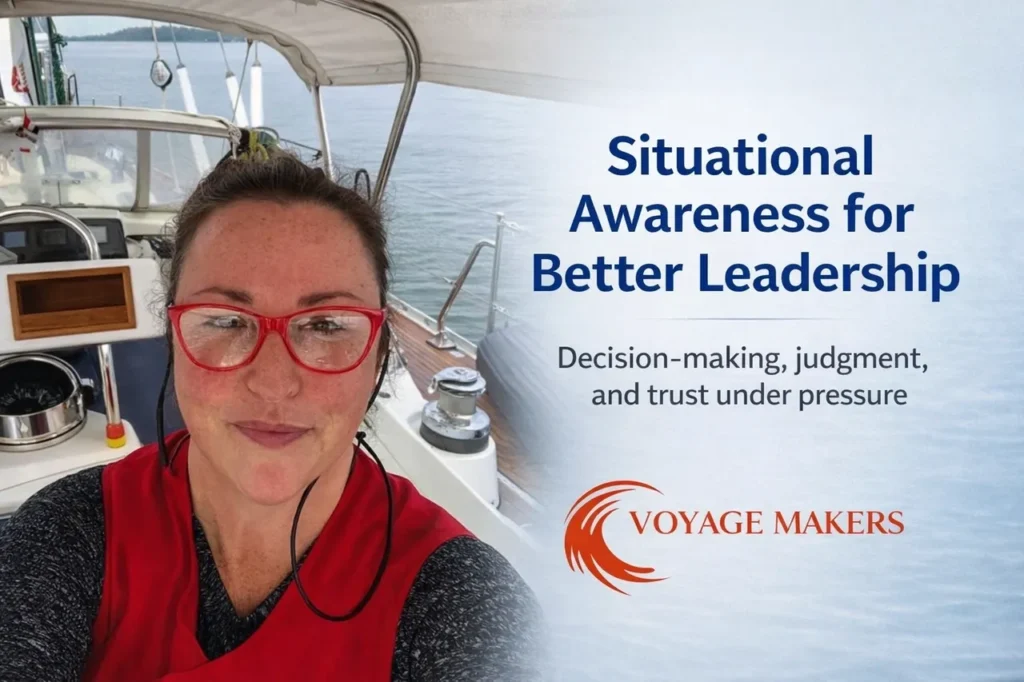
Most leadership failures do not begin as leadership failures. They begin with bad reads, bad assumptions and a refusal to reset.
A team misses what’s changing. A founder pushes a plan that no longer fits reality. A manager confuses confidence with control. Problems that could be solved with a conversation are avoided until they become expensive. By the time the issue looks like a “leadership problem,” the conditions creating it have been building for some time.
Docking a boat makes this painfully obvious.
Docking provides one of those rare moments where bad judgment becomes visible immediately. There is no place to hide. You cannot fake it. Confidence, ego and good intentions will not save you. You either read the situation well – or you don’t.
That is why docking has more to teach us about leadership, decision-making, and trust under pressure than most boardrooms.
The Myth of the Strong Leader
Business culture still rewards a particular kind of leader: decisive, fast, certain, unshaken. The innovator. The person who “trusts their gut.”
It’s a seductive model.
It is also how people drive boats into the dock. In close-quarters, the most dangerous person is rarely the least experienced. It’s the one who resists input, stays the course too long – confuses certainty with capability. That is true in business too.
Many costly decisions are made by leaders who are:
- overly attached to the original plan.
- too committed to the appearance of harmony to allow disagreement, and/or
- too uncomfortable to slow down long enough to reassess.
That’s not strength. That’s ego wearing a lanyard.
Situational Awareness Is the First Real Leadership Skill
Situational awareness is risk assessment: the ability to determine whether the system you are operating can perform.
Most bad decisions do not begin with bad intent – they begin with bad assessment. Someone moves too quickly. Misses what is changing. Assumes the system can carry more than it actually can. By the time it shows up as a “decision problem,” the imbalance was already there.
On the water, good judgment depends on reading three operating systems at once: the environment, the vessel, and the human.
Environment: external conditions you cannot control:
- On a boat – wind, current, weather, traffic.
- In business – your market, timing, competition, external pressure.
Vessel: the platform you are operating:
- On a boat – systems, reliability, limitations, readiness.
- In business – infrastructure, capital, systems, operational readiness.
Human: the most dynamic (and most valuable):
- skill, fatigue, leadership clarity, communication, team alignment.
Good judgment depends on system balance. When one part of the system is overloaded, the quality of the decision depends on the strength of the other systems – risk assessment happens before and as conditions change – when docking a boat or leading a business.
Perception Precedes Strategy
Before strategy, there is perception. Perception is never neutral.
It is shaped by pressure, ego, assumptions, time pressure, past success, and whatever we are emotionally invested in being true. That is where most problems begin. Not in execution. In misreading the environment.
Perception is shaped by pressure, ego, assumptions, time pressure, past success and whatever we are emotionally invested in being true. That is where most problems begin. Not in execution. In misreading the environment.
When docking, the real questions are consequential – but not complicated: What is the wind and current doing? What will the boat likely to do next? What is my crew capable of? What will happen if this goes wrong?
That is not overthinking. That is judgment.
In business, the questions are not all that different: What has changed? What are we not seeing? What assumptions are driving this decision? Is the team aligned—or just polite? Are we solving the right problem, or simply the most visible one?
The quality of leadership often comes down to one thing: Can you see the situation clearly before you act on it? Fewer leaders can do this well than we would like to admit.
Judgment Is Not a Trait. It Is a Process.
Good judgment is rarely one dramatic insight. It is a disciplined loop: observe, interpret, decide, adjust, debrief. That is how experienced skippers – and strong leaders – operate.
Good decision-makers aren’t people who make bold calls. They are people who can absorb changing information, update their read without defensiveness and alter course before the damage compounds.
That matters because one of the most expensive habits in leadership is mistaking commitment for wisdom.
Sometimes the strongest move is not pushing through. Sometimes it is backing off, resetting, and taking another approach.
That applies to docking. It applies to hiring. It applies to partnerships. It applies to almost everything worth doing.
The Best Leaders Know When Not to Force It
There is a particular kind of bad decision that happens when people become emotionally attached to making it work. It happens so often, we have many names for this: sunk-cost fallacy, throwing good money after bad, doubling down on a bad call. Whatever you call it, the pattern is the same.
You see it in docking all the time. The angle is wrong. The wind too strong. Instead of resetting, the helm keeps going because they have already started it. That instinct costs people in gelcoat and cash in business.
In business, this sounds familiar:
“We’ve already invested too much to change course now.” “Let’s just get this launched.” “It’ll be fine.” “We can fix it later.”
Sometimes that works. Often, it’s a polished version of denial.
Docking is about managing momentum—knowing where you want to go, whether you are actually getting there and when to start over.
Strong leaders understand: There is no reward for loyalty to an approach that no longer fits reality. Wanting something to work is not conviction. It is attachment. And it is a poor decision-making tool.
Leadership Requires Self-Awareness Under Pressure
One of the most underrated leadership skills is not confidence. It is self-awareness under pressure.
When conditions tighten – whether you are docking a boat or leading through a difficult business moment – your emotional state matters. Not because emotion is the enemy, but because unnoticed emotion shapes decisions.
- Frustration becomes force.
- Urgency becomes poor timing.
- Fear becomes hesitation—or micromanagement disguised as control.
Strong leaders do not just assess the external situation. They assess themselves.
They ask: Am I still thinking clearly? Am I reacting or responding? Has my frustration narrowed my judgment? Should I reset before I continue?
That is not weakness. That is command.
One of the most important moments in docking – and in leadership – is recognizing when you are the part of the system that needs to reset. Not the plan. Not the crew. Not the conditions. You. Sometimes the strongest move is not pushing harder. It is resetting and taking another pass.
People do not need leaders who never feel pressure. They need leaders who can notice pressure without letting it make the decision. In business, that might mean pausing before sending the email, not forcing the meeting, reframing the conversation or reassessing the approach before momentum turns stress into bad judgment.
Teams, crews, clients, and partners are always reading the same thing – whether the person leading is thinking clearly enough to make a sound call. That changes everything.
The Debrief Is Where Trust Is Actually Built
This is the part many people skip. And it is one of the most important.
After a docking maneuver – especially a messy one – there is a moment of relief. You are in. Nobody died. The boat is mostly where it should be. Everyone suddenly becomes very interested in fenders. And then… nothing. No conversation. No reflection. No learning. Just silent agreement to move on and pretend the whole thing was merely “a bit sporty.”
Business teams do this constantly. A launch underperforms. A client interaction goes sideways. A meeting lands badly. A hire does not work out. A project becomes painful for reasons everyone sensed but nobody named. And instead of debriefing honestly, people rush past it. Why?
Debriefing well requires three things many teams are terrible at (because they are hard):
- honesty
- specificity
- emotional maturity
But this is where trust gets built. Not in polished values statements. Not in team-building exercises. In the debrief.
Real debriefs ask:
- What actually happened?
- What did we miss?
- What assumptions were we carrying?
- Where did communication break down?
- What worked?
- What should change next time?
That conversation – when leaders take accountability for their decisions, actions, and reactions – does more than improve performance.
It builds the kind of trust that creates real alignment. Because if people do not feel safe telling the truth, trust never gets very deep. It just gets polite.
Imperfect Moments Build Trust Faster Than Perfect Ones
People do not build trust because you are flawless. They build trust because they see what kind of leader you are when things go sideways.
Do you get defensive? Do you blame? Do you minimize? Do you perform certainty after the fact? Do you quietly punish honesty? Or can you say:
“That didn’t set up well.” “I missed that.” “We need a better system here.” “What did you see from your angle?” “Let’s improve the process.”
That is where credibility deepens. Because the debrief is not simply about learning. It is about proving that your leadership can survive real conditions. And that is rarer than it should be.
Leadership Is Not About Looking in Control
This may be the biggest lesson docking teaches. Leadership is not about looking composed from the dock. It is about being capable of adapting when conditions shift.
To adapt well, you need a clear plan for what you can control, situational awareness for what you cannot, clear communication and an honest debrief after.
In other words: Leadership is not performance. It is seamanship.
The leaders people trust most – in business and on the water – are not the ones trying hardest to look impressive. They are the ones who can read the moment, respond well, and build stronger teams because they are willing to talk honestly about what happened after.
That is not soft. That is elite.
And in business, just like docking, it is often the difference between a clean arrival and an avoidable mess.
Closing Thought
Some of the clearest leadership lessons do not happen in a boardroom. They happen in close quarters—when the margin for error gets smaller and the truth gets harder to avoid.
What is one leadership lesson you have learned from a high-pressure moment?
What’s Next?
April 25-26 Skipper’s Mindset 2-day Seminar at Brentwood Bay Resort – Tickets on Sale Now
Group Courses on Power & Sail – Visit our Calendar for Dates and Details
Private 1:1 Trainings Available – info@thevoyagemakers.com
If you’re not a newsletter subscriber – subscribe now to download Chapter 1 – Tools for Boat Owners and Chapter 2 – Docking Framework from our Skipper’s Mindset™ series.